

Soft Skills More Necessary Than Ever According to New Report
In a world where AI and machine learning is a top desired skill for businesses globally, are we neglecting the human element?

With the rise of AI and integration into daily business tasks, are companies prioritising quick automation over the most important human soft skills? There’s no denying AI has and is completely changing the way we work and live, from using ChatGPT to create meal plans to the use of AI in healthcare automation.
It was recently revealed in the 2025 AI at Work Report that 74% of executives see AI as critical to their company’s success with 60% already ‘aggressively’ using AI to innovate. But with such a focus on automating and decision-making being left to AI – where does that leave core human centric soft skills.
Written by
Sophi Barnes is an experienced Careers Services Consultant with a strong background in career coaching and deep expertise in the tech and project management job markets. She's passionate about supporting people through career transitions and into roles where they can thrive.

How are Soft Skills Related to Using AI Responsibly?
With over half (54%) of organisations now requiring AI skills in early-career roles according to FDM Group's latest report, it's clear that AI skills are a necessity for all UK workers, regardless of where you are in your career. The 300+ cilents surveyed by FDM also highlighted critical thinking and applied problem-solving (22%), creativity and innovation (15%), and ethical judgement (14%), as in-demand skills for graduate roles. Noticeably, these are all soft skills.
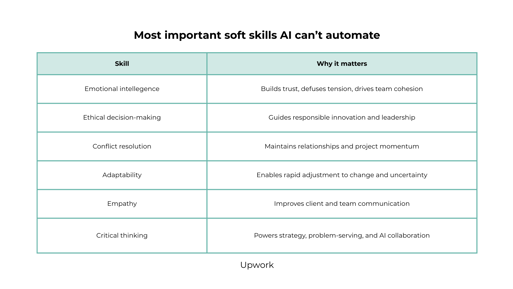
According to the World Economic Forum, 7 out of the top 8 core desired skills for workers globally were soft skills including: resilience, flexibility and agility, leadership and social influence, motivation and self-awareness, empathy and active listening. Soft skills like these are difficult to automate and provide nuances to prompts and requests.
The companies pulling ahead are the ones blending AI with human expertise.
"...leveraging agentic AI with intention, aligning software strategy with business value, and building guardrails to innovate responsibly.
With £5+ billion per year in potential value at stake, the organisations that optimise this human-AI partnership today will define the future of software tomorrow."
Soft Skills are Crucial in the Age of AI
In the age of AI, workers must utilise creativity, adaptability, clear communication, and critical thinking to stay competitive. Responsible AI skills are essential, including AI ethics, spotting bias and understanding its impact on outcomes.
The report says, “workers must balance hard and soft skills to thrive in today’s work environments.”
Soft skills are no longer optional, they’re essential for career growth, resilience, and long-term success in today’s unpredictable job market. Professionals who master empathy, adaptability, and creativity are driving innovation, shaping the future of work, and standing out to employers.
AI is transforming every aspect of our lives, from education to the workplace, and businesses clearly recognise this shift...
"For graduates, this creates a huge opportunity to build the skills that are needed in the current and future workforce. This is especially true considering the gap between organisational appetite for AI and their existing capabilities for successful AI integration...
...The future of AI success lies in human oversight. AI doesn’t replace people, it amplifies those who are equipped to use it wisely."
The Human to AI Connection
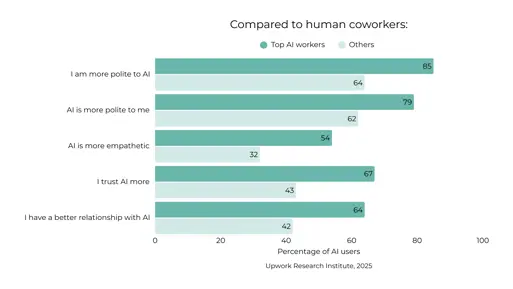
A survey by Upwork revealed that 90% of workers view AI as a coworker: 67% of top AI performers trust AI more than their teammates, with 64% expressing they have a better relationship with AI than their human colleagues.
The survey interestingly revealed more insights into the human – AI connection, like how 85% of people who use AI frequently reporting they are more polite to AI than their co-workers and that 79% found AI was more polite to them.
These figures indicate a clear divide between human-to-human interaction which highlights a gap in basic human soft skills. How can this be rectified and how can soft skills create better use of AI?
Soft Skills Verses Hard Skills in IT
Unsure of the difference between hard skills and soft skills, or how best to utilise them to progress in your IT career?
Read our up-to-date guide on hard skills and soft skills.

Building on Interpersonal Skills for Optimum Output from Humans and AI
Not only are soft skills essential for success in your career, but they are also crucial to correct use and implement AI within the workforce. In Tech and IT, soft skills are fundamental for team-based environments.
From communication and empathy to creativity and time management, soft skills cover a variety of areas, and our Business Skills courses will equip you with everything you need for a successful career.
Our Pathway of quality courses covers topics such as influence and persuasion, presentation skills, critical thinking, risk management and more which you can continue to develop throughout your career.
Investing in professional development now ensures you’re ready to thrive in a rapidly changing world of work.
Why not arrange a free call with one of our expert career consultants to discuss your future today.
Related Articles
 AI
AIJobs That Are AI Proof in the Tech Sector: A List for 2026
AI is certainly disrupting the tech sector and job markets across the globe, but there are some roles and skillsets which simply can't be replaced by AI in 2026.
Read More Cyber Security
What Is Cyber Security & Why Is It So Important in 2026?
Cyber security is more important than ever before — and so is filling the cyber skills gap in the UK with trained professionals! I'll cover the foundations of what cyber security is, what it entails, and why it's increasingly important for corporate and national safety, as well as what a career in this sector can look like.
Read More Cyber Security
What Is Phishing in Cyber Security?
Understand what phishing is in cyber security, how these attacks work, and why they matter for individuals, businesses, and future cyber security professionals.
Read More AI
AIHow to Prepare for AI’s Impact on the UK Job Market and Careers
The "AI is stealing all the jobs" talk is scary. My best advice: don't panic, prepare. In this guide, I've used current statistics to tell a story of how AI is impacting the UK job market and how you can future-proof your career for this digital revolution.
Read More